Guide to Blackjack for Beginners
 By Jamie Dickenson,
Editor at online-gambling.com
Jamie Dickenson
Editor at online-gambling.com Blackjack is one of the most popular casino card games in the world, where players aim to get their hand as close to 21 as possible without going over. A hand of 21 from your first two cards is called a ‘blackjack’. This is a comparing card game, so you play against the dealer rather than against other players like in poker.
Blackjack has origins in the game ‘twenty-one’, dating back to Spain in the 17th century, but it was not until the 1770s that the game’s first rules appeared in Britain and 1899 when it was developed into an American variant and renamed ‘blackjack’.
Today it is one of the most common table games found at land-based and online casinos. One reason it is a beginner favorite is the math: with correct basic strategy, blackjack carries a house edge of roughly 0.5%, among the lowest of any casino game (figure varies by table rules; verify against the specific game). In this beginner’s guide to blackjack we will give you the information you need to play for the first time.
- Blackjack Rules for Beginners
- How to Play Blackjack
- Blackjack Strategy for Beginners
- Basic Strategy Quick-Reference Chart
- Why the 3:2 vs 6:5 Payout Matters
- More Beginner Blackjack Strategy Tips
- More General Blackjack Tips
- Common Beginner Mistakes
Blackjack Rules for Beginners
Blackjack is a card game in which players try to get their hand closer to the value of 21 than the dealer’s hand without going bust, which is when you go over 21. Every card is worth its number in value, while the face cards Jack, Queen and King are all worth 10, and Aces are worth either 1 or 11, depending on what suits your hand. The game is played with one or more decks of regular playing cards.
The aim of blackjack is simply to have a higher-value hand than the dealer without going over 21. You are dealt two cards to start with, then you choose to either ‘hit’ to receive more cards or ‘stand’ to keep your current hand as it is. The dealer also takes two cards, with one of them face up so it can be seen and one face down.
You can choose to ‘hit’ and add as many cards as you like, but if the value of your hand exceeds 21 at any point, you go ‘bust’ and lose the hand. If neither the player nor the dealer busts, then the higher-value hand wins.
If you beat the dealer with a regular win, you receive an even-money payout of 1:1. If you win with a blackjack (an Ace plus a 10-value card on your first two cards), you should be paid 3:2, meaning a $10 bet returns $15 in winnings. Some tables only pay 6:5 on a blackjack, which is much worse for the player, and we explain why below.
One rule worth remembering is that the dealer must hit on any hand valued at 16 or below and stand on 17 or more. (At some tables the dealer also hits a ‘soft 17’, which is a 17 made with an Ace counted as 11; this rule favors the house, so check the table before you sit down.) If you choose to double down, you double your wager for the hand but receive only one more card.
How to Play Blackjack
Here is a simple step-by-step guide to playing blackjack for beginners:
- Place a bet before the cards are dealt. The minimum and maximum bets are flagged on the table.
- Once all bets are made, the dealer deals two cards to each player and takes two cards as well, one face up and one face down.
- When it is your turn, you choose to ‘hit’ and receive more cards or ‘stand’ and keep your hand as it is. You may also be able to double down, split a pair, or surrender, depending on the table rules.
- When all players have had their turn, the dealer turns over their face-down card and then hits until reaching at least 17, after which they must stand.
- Anyone who goes bust loses immediately, and the highest-value hand that has not busted wins.
Blackjack Strategy for Beginners
New players will find it useful to follow a solid strategy, which helps you get familiar with the game and improves your chances of success. The decisions below are the core of blackjack basic strategy, the mathematically proven ‘correct’ play for each situation. They are based on your hand against the dealer’s face-up card.
Always Split Aces and 8s
If you are ever dealt a pair of Aces or 8s, it is correct to split them into two separate hands. Splitting two Aces lets you start two hands with a value of 11, each waiting on one more card. Splitting two 8s lets you escape a weak total of 16, which is one of the hardest hands to win with; you turn one bad hand into two hands that each start on 8.
Stand on 12-16 When the Dealer Shows 2-6
If your hand totals between 12 and 16 (with no pair) and the dealer’s face-up card is 2 through 6, it is generally correct to stand. A low dealer card busts often, so you let the dealer take the risk rather than risking a bust yourself.
Hit on 12-16 When the Dealer Shows 7-Ace
If your hand totals between 12 and 16 (with no pair) and the dealer shows a strong card of 7 through Ace, then you should hit. The dealer is likely to finish with a strong total, so standing on a weak hand would usually lose; hitting gives you a chance to compete, even though you risk going bust.
Double Down on 11 When the Dealer Shows 2-10
If your hand totals 11 and the dealer’s face-up card is 2 through 10, it makes sense to double down. You have a strong starting total with a good chance of drawing a 10-value card for 21, so you put more money in when the odds favor you.
Hit or Double Down on Soft Hands of Ace Plus 2-6
If you hold an Ace with a card from 2 through 6 (a ‘soft’ hand), you should either double down or hit, depending on the dealer’s card. Because the Ace can count as 1 or 11, you cannot bust on the next card, which opens up more ways to build your hand.
Never Split Two 10-Value Cards
A common beginner mistake is to split a pair of 10s or face cards. A total of 20 is already an excellent hand, and the numbers show you win more often by standing on 20 than by breaking it up into two new hands.
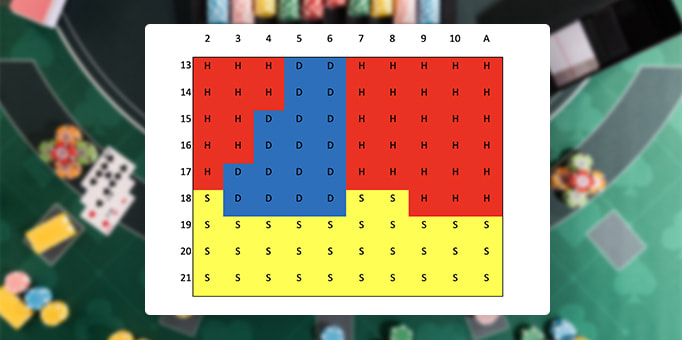
Basic Strategy Quick-Reference Chart
You can keep these core moves on hand while you learn. They assume a standard multi-deck game where the dealer stands on all 17s:
- Hard 8 or less: always hit.
- Hard 11: double down against a dealer 2-10, otherwise hit.
- Hard 12-16: stand against a dealer 2-6, hit against 7-Ace.
- Hard 17 or more: always stand.
- Soft 13-16 (Ace plus 2-5): hit, or double against a dealer 4-6.
- Soft 19 or more: stand.
- Pair of Aces or 8s: always split.
- Pair of 10s, 5s, or 4s: never split.
- Surrender (where offered): a hard 16 against a dealer 9, 10, or Ace is the classic spot to give up half your bet.
A full strategy chart covers every hand-versus-dealer combination, and many casinos allow you to keep a printed chart at the table. Following it consistently is what keeps the house edge near 0.5% (verify the exact figure against the rules of the table you play).
Why the 3:2 vs 6:5 Payout Matters
Before you sit down, check what the table pays for a blackjack. A 3:2 table returns $15 on a $10 blackjack, while a 6:5 table returns only $12 for the same hand. That difference looks small, but switching from 3:2 to 6:5 adds roughly 1.4% to the house edge, which is more damage than most other rules combined (verify against the specific game).
For a beginner, the single easiest way to improve your odds is to only play tables that advertise ‘Blackjack Pays 3 to 2’ and avoid any that pay 6:5.
More Beginner Blackjack Strategy Tips
There are other basic tips that new players should know:
- Always check the dealer’s face-up card before deciding what to do with your own hand.
- Assume the dealer’s face-down card is worth 10, since 10-value cards are the most common in the deck.
- If your hand is worth 17 or more, then stand.
- If your hand is worth 10 or 11 and the dealer’s face-up card is 9 or lower, then double your bet.
It also helps to know the difference between a ‘hard hand’ and a ‘soft hand’. If your hand has no Ace, or the Ace has to count as 1 because counting it as 11 would bust you, then you have a ‘hard hand’, and there is no flexibility in the value of the hand.
If you have a hand with an Ace that you can count as either 1 or 11, then this is a ‘soft hand’. This gives you more flexibility in the value of the hand and more options if you draw additional cards. Some tables require the dealer to hit a soft 17, while others have them stand, so be sure to check the rules before you play.
If the dealer shows an Ace, they will offer players insurance, a side bet that pays if the dealer turns over a blackjack. We cover why this is best avoided below.
On some tables you can surrender half your bet if you do not like your hand once it is dealt. If you and the dealer both have a blackjack, the hand is a ‘push’, which is a tie and your bet is returned. When the dealer shows an Ace and you have a blackjack, you may be offered ‘even money’, a 1:1 payout instead of the standard 3:2; this is the same poor bet as insurance, so it is usually better to decline and take your 3:2.
More General Blackjack Tips
Here are some more general tips to help you play your best.
Manage Your Bankroll
To play blackjack well, it is important to manage your bankroll carefully. Decide on a budget before you play and choose how much you are willing to risk on each hand. Never wager more than you can afford to lose, and as a general rule, keep each bet to no more than 1-2% of your total bankroll.
Avoid Insurance Bets
It can be tempting to take insurance when the dealer shows an Ace, but the bet has a negative expected value over the long term. The dealer completes a blackjack less than one time in three from an Ace up, so the 2:1 insurance payout does not cover the risk. We advise skipping insurance entirely and focusing on solid basic-strategy decisions instead.
Practice First
Every beginner’s guide to blackjack will tell you to get as much practice as possible when starting out. Playing free games on online blackjack sites is a good way to learn the game at no cost, after which you can try a land-based casino. You can test your strategies here as well as trying new approaches.
Start With Small Bets
Starting on low-minimum tables helps you build up your blackjack experience, since you can play more hands without risking much money. You will get used to the pace and flow of the game, and you can watch how other players act and interact with the dealer to improve your understanding. You may even pick up tips from other players along the way.
Low-stakes tables also tend to attract less experienced players, so you are not up against seasoned pros. That gives you room to refine your own strategy while watching how others play and learning from their mistakes, which helps when you move up to higher-stakes tables.
Interact With the Dealer
We recommend chatting with the dealer when it feels appropriate, as it can make your session more enjoyable. A bit of light conversation helps build a rapport, and some friendly dealers may even answer questions about the game.
A Note on Card Counting
You may have heard that card counting can beat blackjack. Counting is legal in most places because it is a mental skill rather than the use of a device, but casinos are private businesses and can ask counters to leave or bar them. It also takes considerable practice, only gives a small long-term edge, and is largely defeated by continuous shuffling machines and by online games that reshuffle every hand.
For the real-world story of how a famous team applied it, read about the MIT Blackjack Team. For most beginners, sound basic strategy is the more practical path.
Stay Positive
This trait is underrated, but try to stay positive while playing blackjack and remember that, as a game of probability, you will hit winning streaks as well as losing runs. Managing your emotions has a real impact on your decisions, so stay calm and measured.
Common Beginner Mistakes
Knowing the most frequent errors can save you money early on:
- Taking insurance or even money: both are negative-value bets that drain your bankroll over time.
- Playing 6:5 tables: the worse payout quietly costs you far more than a single bad decision.
- Splitting 10s or standing on a pair of 8s: breaking up a strong 20 or keeping a weak 16 both go against basic strategy.
- Mimicking the dealer: always hitting until 17 ignores the dealer’s up-card and gives back much of your edge.
- Chasing losses: raising your stakes to recover a losing run is the fastest way to empty a bankroll.
 Russian Roulette Origin – Story Behind the Game
 Biggest Casinos in the United States – Overview of the Top 10
 The Most Popular Roulette Betting Strategies
 Overview of the US Online Gambling Laws by State
 Easiest Casino Games to Win – Review & Analyze
 Ranking of All-Time Biggest Lottery Winners
 Top 15 Casino Movies on Netflix Streaming Right Now
 All You Need to Know About the 2023 NCAA Tournament
 The Best NFL Team Ever