How to Play Caribbean Stud Poker: Rules and Payouts
 By John Isaac,
Editor at online-gambling.com
John Isaac
Editor at online-gambling.com | Rules Difficulty | Easy |
|---|---|
| House Edge | 5.22% of the ante |
| Element of Risk | 2.56% |
| Dealer Qualifies With | Ace-King or better |
| Simple Strategy | A-K-J-8-3 or better |
Caribbean Stud Poker Free Demo
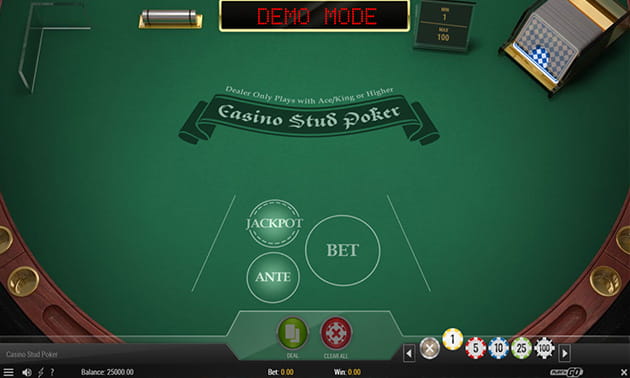
Caribbean Stud Poker is five-card poker played against the dealer, with one decision in it: after seeing your hand you either raise or fold. There is no drawing, no bluffing and no other players, which makes it one of the quicker table games to learn and one of the easier ones to play badly. The demo below runs on play credits, so you can work through the raise-or-fold call before any money is at stake.
 Play
PlayHow to Play Caribbean Stud Poker – Beginner’s Guide
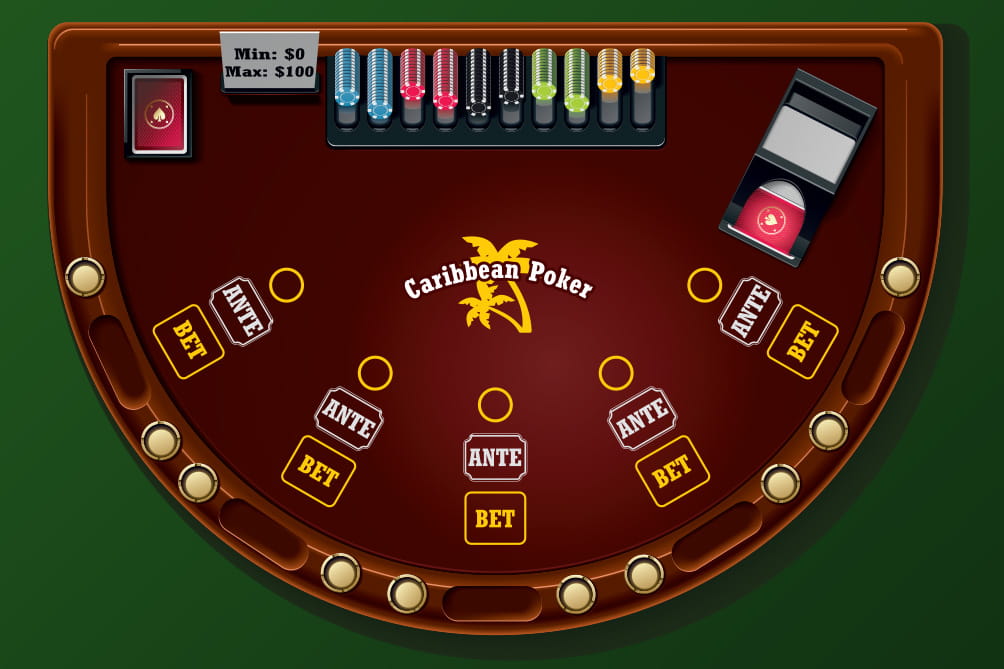
Caribbean Stud Poker is played against the dealer, never against other players. You post an ante, and both you and the dealer are dealt five cards. You see all five of yours and one of the dealer’s, then choose between folding, which forfeits the ante, and raising, which costs twice the ante. Both hands are then turned over and the higher poker hand wins. That is the entire game.
Caribbean Stud Poker Rules – Learn How to Play
Caribbean Stud Poker is played with a standard 52-card deck, of which five cards are dealt to both the player and the dealer. Before being dealt a hand, the player has to decide what bets to place for the current round. They can choose to post just the ante bet or to place an additional side bet that could be called either ‘Jackpot’ or ‘Bonus’. Once the bets are placed, the player is dealt a hand. If they like the hand and want to play against the dealer, the player must raise by placing twice the ante. The winner is determined in the subsequent showdown. Here’s what you need to know to stand a chance of winning.
- You must post the ante to be dealt in. A progressive jackpot side bet is optional and separate.
- After seeing your five cards and the dealer’s up card, you either fold or raise. The raise is always exactly twice the ante.
- Folding forfeits the ante immediately. Your cards are not shown.
- The dealer needs ace-king high or better to qualify.
- If the dealer does not qualify, the ante pays even money and the raise is returned to you, however strong your hand is. This happens on about 44% of hands and is the rule that shapes the whole game.
- If the dealer qualifies and you win, the ante pays even money and the raise pays on the fixed table below.
- If the dealer qualifies and beats you, you lose both bets. Identical hands push.
- The progressive jackpot is settled on your five cards alone, whatever the dealer holds.
The non-qualifying rule is worth reading twice. Almost half the time your raise wins nothing at all, no matter how good your cards are, and that single quirk is where most of the house’s advantage comes from. If you already know poker hand rankings you can skip the next section.
Online Caribbean Stud Poker Hands – All You Must Know
The hands in Caribbean Stud Poker are the standard poker hands. Below, you can find the complete list of hands you should be able to recognize.
- Royal Flush – For this to be the case, your hand must contain the cards from 10 to Ace, all being of the same suit.
- Straight Flush – Five cards in sequence, all of the same suit. For example the 5 through 9 of hearts.
- Four of a Kind – The name is self-explanatory. All you need is four cards of the same kind and the fifth card is irrelevant. Imagine yourself holding four aces – that’s the spirit!
- Full House – All five cards are important here. You need three of a kind plus a pair to complete a Full House hand.
- Flush – A valid Flush can be played when the player holds any five cards of the same suit. Those could be five clubs, hearts, spades, or diamonds.
- Straight – For a Straight, the player must be dealt five connected cards. For example, holding all five cards from 2 to 6 completes a straight.
- Three of a Kind – Three of a Kind or a Set is when the player holds three cards of the same kind (e.g. three Tens).
- Two Pair – In order to complete Two Pair, the player must have two separate pairs in their hand. The kicker comes into play here.
- All Other – One Pair and High Card are also valid poker hands. One Pair is simply two cards of the same kind. High Card is the highest card in the player’s hand.
The best hand is a royal flush, and it is genuinely rare: the odds are about 1 in 650,000, or 0.00015%, not the fraction of a percent that some guides quote. What you will actually be dealt most of the time is one pair or nothing at all, which together account for over 92% of hands, so the raise-or-fold decision almost always comes down to the marginal cases covered further down.
Odds and Payouts
This is the pay table for the raise bet, and it applies only when the dealer qualifies and you beat them. The ante always pays even money regardless of your hand, so a royal flush earns 100 to 1 on the raise and 1 to 1 on the ante. The probabilities below are the real chances of being dealt each hand from a 52-card deck, which is a different thing entirely from what the payout implies.
| Your Hand | Raise Pays | Chance of Being Dealt |
|---|---|---|
| Royal Flush | 100:1 | 0.00015% |
| Straight Flush | 50:1 | 0.0014% |
| Four of a Kind | 20:1 | 0.024% |
| Full House | 7:1 | 0.14% |
| Flush | 5:1 | 0.20% |
| Straight | 4:1 | 0.39% |
| Three of a Kind | 3:1 | 2.11% |
| Two Pair | 2:1 | 4.75% |
| One Pair or Less | 1:1 | 92.37% |
Put those two columns side by side and the shape of the game becomes clear. More than nine hands in ten are a pair or worse, paying the raise at 1 to 1, which makes the headline numbers at the top of the table close to decorative. Pay tables do vary a little between operators, usually on the flush and full house rows, so check the rules screen before you sit down.
The Progressive Jackpot Side Bet
Most Caribbean Stud tables carry a progressive jackpot, taken as a flat side bet of one unit placed before the deal. It is settled on your five cards alone: the dealer’s hand is irrelevant, and you still collect if you folded the main bet.
Pay tables differ between operators, but the usual structure gives fixed amounts for the smaller hands and a share of the meter for the big two.
| Hand | Typical Jackpot Payout |
|---|---|
| Royal Flush | 100% of the meter |
| Straight Flush | 10% of the meter |
| Four of a Kind | Fixed, often 500 units |
| Full House | Fixed, often 100 units |
| Flush | Fixed, often 50 units |
The catch is what it costs. Averaged across the pay tables in circulation, the progressive carries a house edge of around 26%, which makes it one of the most expensive bets in a casino and roughly five times the price of the main game. It only tips toward the player when the meter grows very large, and the break-even point runs from tens of thousands to several hundred thousand depending on the pay table. Treat it as a lottery ticket, not as part of a strategy.
House Edge and RTP
Caribbean Stud is usually quoted with two different numbers, and they are not a range. The house edge is 5.22%, measured against the ante alone. The element of risk is 2.56%, measured against everything you actually put on the table, which is the fairer comparison, because you raise on only about half of hands and the raise is twice the size of the ante.
The practical figure is that 2.56%, or an RTP of roughly 97.44% on the money you wager. That puts the game a little behind blackjack and comfortably ahead of most slots, as long as you leave the progressive side bet alone. Both numbers assume you play the raise-or-fold decision correctly, which the strategy section covers.
Caribbean Stud Poker Online Games – Live and RNG Variations
You will find Caribbean Stud in both RNG and live dealer form. The difference is in how the cards are dealt rather than in the payouts and odds: a live table has a real dealer working in real time, while an RNG version draws from a shuffled virtual deck. Both are unpredictable from one round to the next. Playing online has a few advantages over a land-based table.
- No waiting on other players, so you see far more hands per hour
- Lower table minimums than most land-based casinos
- The pay table and rules screen are always one tap away
- Free demo versions to practice the raise-or-fold call
Several major studios build the game. The demo on this page is Play’n GO‘s Casino Stud Poker, Games Global, formerly Microgaming, has its own take called Cyber Stud Poker, and Playtech supplies a widely stocked variant.
Which of these reaches your lobby depends on where you play and which software providers the casino carries. Our US casino guide and Philippines casino guide cover the licensed sites in each market, along with the payment methods and legal rules that apply there.
Our Caribbean Stud Poker Tips – Learn How to Win
There is no formula that beats the house here, but there is a correct way to play the one decision the game gives you, and most players get it wrong by folding too often. Practice on the free version first, then work through the points below.
- Learn the raise-or-fold rule before anything else. It is the only decision in the game and the only thing that changes what it costs you.
- Raise on every pair, however small. A pair of twos still beats the dealer’s ace-king, which is their most common qualifying hand.
- Practice on the free demo until the marginal ace-king hands stop making you hesitate.
- Remember the non-qualifying rule. On roughly 44% of hands your raise is simply handed back, so a strong hand is worth less than it looks.
- Skip the progressive side bet unless the meter is genuinely enormous. At around 26% it is the most expensive thing on the table.
- Set a bankroll you can afford to lose before you start, and remember that a raise commits three times your ante in total.
- Know when to stop – set a time limit alongside your budget, and never chase losses.
The next section gives the actual rule. It is short, and following it gets you within a rounding error of mathematically perfect play.
Caribbean Stud Poker Strategy – When to Raise and When to Fold
Computer analysis has solved this game, and the perfect strategy is a long list of edge cases nobody memorizes. The practical version fits in three lines, and it gives up 0.001% against perfect play, which is nothing.
- Raise with any pair or better. Even a pair of twos is worth raising, because the dealer fails to qualify almost half the time and ace-king is their most likely qualifying hand.
- Fold anything below ace-king. If your best five cards do not reach ace-king high, the raise loses money.
- With exactly ace-king, raise if the dealer’s up card matches one of your five cards, or if the dealer’s up card is a queen or lower and you also hold a queen or jack. Otherwise fold.
If even that is more than you want to carry, there is a one-line version. Raise on ace-king-jack-8-3 or better, comparing card by card from the top, and fold everything below it. Read your hand highest card first: an ace beats the threshold’s ace only if the rest is stronger, so A-K-J-9-2 is a raise and A-K-10-9-8 is a fold. It is a blunt rule, but it captures nearly all the value of the full strategy.
One thing no strategy fixes: folding is right on about 48% of hands, so a session will involve a lot of throwing cards away. That is the game working as designed, not a run of bad luck.
Final Thoughts
Caribbean Stud is easy to learn and easy to misplay. Two rules carry almost all of it: raise on any pair, and fold below ace-king. Get those right and you are playing a 2.56% game. Chase the progressive on every hand and you are paying ten times that for the privilege.
The non-qualifying dealer is what makes the game feel unfair when you turn over a full house and collect even money on the ante alone. It is not a glitch; it is the whole reason the pay table can afford to offer 100 to 1. If you would rather have your poker hands settled without that quirk, our Casino Hold’em guide covers a game with a similar shape and a lower edge.
Popular Questions
Here are the questions players ask most often about Caribbean Stud Poker.
1. How to play Caribbean Stud Poker?
To be dealt in, the player must first place an ante wager. After they see their hand, the player must decide whether to raise or fold. In the first case, they go up against the dealer and compare the strength of their hands. In the second case, the player forfeits their hand and the ante.
2. What are the Caribbean Stud Poker rules?
These are the Caribbean Stud Poker rules:
- All players post ante.
- Everyone (including the dealer) is dealt five cards. One of the dealer's cards is face-up, the rest are face-down.
- The players who want to enter the showdown stage raise.
- The dealer compares their hand with each player individually to decide whether their bets win or lose.
3. How to win at Caribbean Stud Poker?
Avoid folding small pairs. Quite often they prove good against the hand of the dealer. If you happen to be dealt a weak hand, don't hesitate to fold. Always compare the face-up card of the dealer with the cards you're holding. Implement any advanced tips for Caribbean Stud Poker into your game.
4. What is the best Caribbean Stud Poker strategy?
The best strategy is simple: raise with any pair or better, and fold anything below ace-king. The marginal ace-king hands depend on the dealer's face-up card. Our strategy section gives the full three-line rule.
5. Where can I find a Caribbean Stud Poker free game?
Free demo versions can be found all over the net. A Caribbean Stud Poker free demo is available on our page as well. You can use it as a practice tool to gain experience playing the game.
6. Where can I play Caribbean Stud Poker for real money?
Licensed operators are the perfect place to both try out Caribbean Stud Poker and play it for real money. Such casinos also offer a sizeable welcome bonus for new players. You can find licensed operators in our US gambling guide or our Philippines casino guide.