How to Play Pai Gow Poker: Rules, Hands and Strategy
 By John Isaac,
Editor at online-gambling.com
John Isaac
Editor at online-gambling.com | Rules Difficulty | Medium |
|---|---|
| RTP | 97.49% |
| House Edge | 2.51% |
| Commission on Wins | 5% |
| How to Set Hands | The House Way |
Free Pai Gow Poker – Try Our Demo
Pai Gow Poker takes the hand rankings you already know from poker and asks you to do something unusual with them: split seven cards into two separate hands that both have to beat the dealer. That single decision is where the skill in this game lives. The demo below runs on play credits, so you can practice splitting hands before any money is involved.
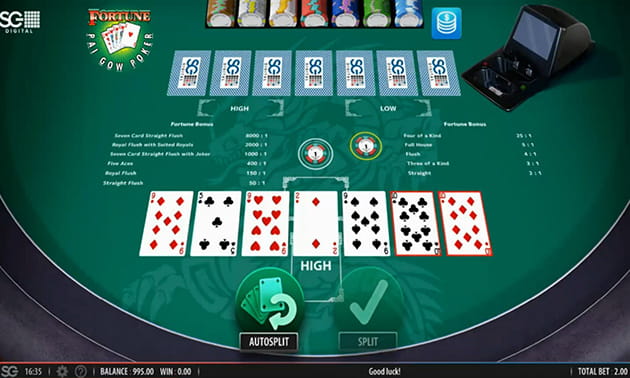 Play
PlayHow to Play Pai Gow Poker – Beginner’s Guide
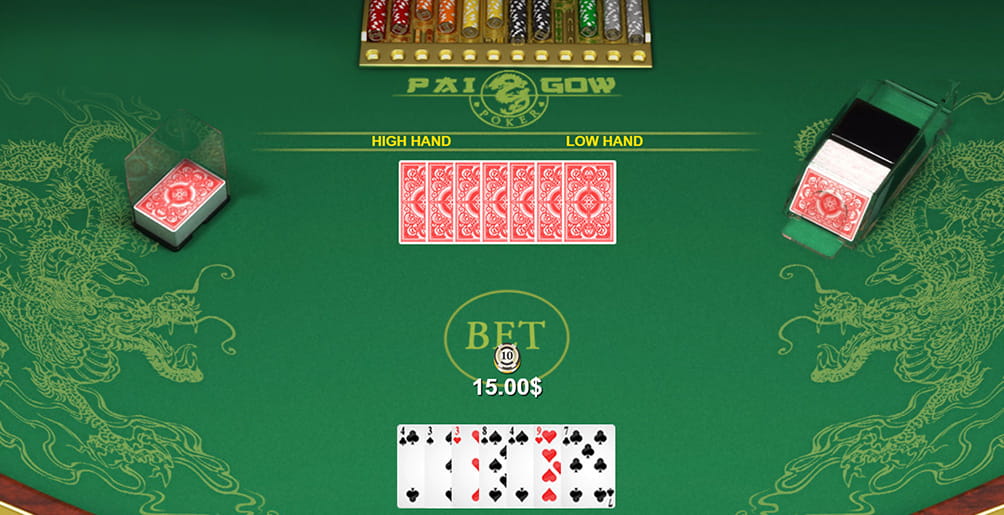
If you know poker hand rankings, most of Pai Gow Poker is already familiar. The game is played with a standard 52-card deck plus one joker, and both you and the dealer are dealt seven cards. Your job is to split those seven cards into a five-card high hand and a two-card low hand, and both of yours have to beat both of the dealer’s. Win one and lose the other and the hand is a push. Below is a picture of the typical Pai Gow Poker table layout.
Pai Gow Poker Rules – What Beats What
The basic rules boil down to splitting your seven cards into a five-card high hand and a two-card low hand. The high hand must outrank the low hand. Setting them the other way around is a foul, and depending on the house the hand is either reset for you or forfeited. The dealer then sets their own seven cards by a fixed procedure called the house way, and the two high hands and the two low hands are compared separately. If you want to spice things up, Pai Gow Poker side bets are usually on offer too.
- Win both hands and you win the bet, paid even money less a 5% commission.
- Lose both hands and the dealer takes the bet.
- Win one and lose the other and the hand is a push, which happens roughly 40% of the time.
- Identical hands go to the dealer, so a copy hand is a loss and not a push.
- The joker is semi-wild: it counts as an ace, or completes a straight, a flush or a straight flush.
The 5% commission is the detail most new players miss. It applies only to winning bets, so a $10 win returns $9.50 rather than $10. Together with the copy-hand rule, that commission is where the house makes its money, and it is the reason a game you push almost half the time still turns a profit for the casino.
Pai Gow Poker Hands – Rankings and the Joker
Both hands are ranked by standard poker rules, with one addition. Five aces, made from the four natural aces plus the joker, is the highest hand in the game and beats a royal flush. The joker itself is not fully wild: it plays as an ace, or it completes a straight, a flush or a straight flush, and nothing else.
- The five-card high hand – Ranked exactly as in poker, from high card up to five aces. Anything from a straight upwards is a strong high hand.
- The two-card low hand – Only two shapes exist here: a pair, or two unpaired cards ranked by the higher one. A pair of aces is the best low hand you can hold, and ace-king is the best unpaired one.
You set the hands yourself, dragging cards into the areas of the table marked ‘high’ and ‘low’. The whole skill of the game sits in that one choice, and the house way section below covers how to make it.
Pai Gow Poker Side Bets – Your Options
Which side bets are on the table depends on the software version you are playing. They are worth knowing about, with one caveat: every one of them carries a far higher house edge than the main bet, usually in the 7% to 8% range. Here are the most common ones.
- Fortune Pai Gow – A game variant including quite a few side bets based on the dealer’s and the player’s cards.
- Pai Gow Mania – This variation includes two side bets concerning the first three and all seven of the cards dealt to the player.
- Emperor’s Challenge – Winning a side bet in this variation gives you a share of a progressive jackpot according to the game’s pay table.
- Progressive Fortune Pai Gow – This game features a progressive jackpot, which could be yours if you make a 7-card straight flush.
Some players prefer the Dealer Bonus, which pays on the strength of the dealer’s hand. The logic is that it works as partial insurance: if the dealer turns over a straight flush, you were probably losing the main bet anyway. Payouts are lower than on the side bets that track your own cards.
Odds and Payouts
The main bet is simple: win both hands and you are paid even money, less the 5% commission. The eye-catching numbers in Pai Gow Poker come from the Fortune side bet, which pays on the best five-card hand you can make out of your seven cards, no matter how you end up splitting them. The pay table below is the Fortune bonus, not the main bet, and the exact figures vary between operators.
| Best Five-Card Hand | Fortune Bonus Payout |
|---|---|
| 7-Card Straight Flush (no Joker) | 8,000 to 1 |
| Royal Flush plus Royal Match | 2,000 to 1 |
| 7-Card Straight Flush with Joker | 1,000 to 1 |
| Five Aces | 400 to 1 |
| Royal Flush | 150 to 1 |
| Straight Flush | 50 to 1 |
| Four of a Kind | 25 to 1 |
| Full House | 5 to 1 |
| Flush | 4 to 1 |
| Three of a Kind | 3 to 1 |
| Straight | 2 to 1 |
A royal match is a suited king and queen in the low hand, which is why that second row pays so well. Those top payouts are real, but they are rare enough that the Fortune bet still costs roughly 7% to 8% of everything staked on it. Check the pay table in the game rules before you bet, because it changes from one operator to the next. The main bet, at around 2.5%, is much better value.
House Edge and RTP
The house edge is the share of your bet the casino expects to keep over the long run. In Pai Gow Poker it comes from two places: the 5% commission on winning bets, and the rule that copy hands go to the dealer. Played with optimal hand-setting against a dealer bank, the main bet carries a house edge of about 2.51%, which is one of the lower figures on the casino floor.
Seen from the other side, that is an RTP of roughly 97.49% on the main bet. Two things move it. Setting your hands badly costs real money, which is why the house way is worth learning. And the side bets are measured separately: the Fortune bonus returns closer to 92%, so folding it into the main bet’s RTP gives a misleading picture of the game.
Setting Your Hands: The House Way
The dealer does not get to think. They set their seven cards by a fixed procedure called the house way, and a player who follows that same procedure gives up only about 0.2% against perfect play. One principle drives every rule in it: make the two-card low hand as strong as you can without giving away the five-card high hand.
House ways differ slightly between casinos, so check the game rules if the software offers to set your hand for you. The version below is the one most operators use.
| What You Are Dealt | How to Split It | Example |
|---|---|---|
| No pair | Highest card stays in the high hand, the next two highest go low. | A-J-9-7-5-4-2 → high A-9-7-5-2, low J-4 |
| One pair | Pair stays high, the two highest remaining cards go low. | K-K-Q-J-8-5-3 → high K-K-8-5-3, low Q-J |
| Two pair | Usually split, one pair in each hand. Keep both pairs high only when they are small and you hold an ace or king to play low. | Q-Q-7-7-A-6-3 → high Q-Q-A-6-3, low 7-7 |
| Three pair | Highest pair goes low, the other two stay high as two pair. | A-A-9-9-4-4-K → high 9-9-4-4-K, low A-A |
| Three of a kind | Keep it together in the high hand. The one exception is three aces: play a pair of aces high and the third ace low. | A-A-A-K-8-6-2 → high A-A-8-6-2, low A-K |
| Straight or flush | Play it in the high hand, unless you can pull two better cards out of it for the low hand and still keep the straight or flush intact. | 9-8-7-6-5-K-Q → high 9-8-7-6-5, low K-Q |
| Full house | Split it: three of a kind high, the pair low. | J-J-J-8-8-6-2 → high J-J-J-6-2, low 8-8 |
| Four of a kind | Depends on rank. Twos through sixes stay together; sevens through tens split unless you already hold an ace or a pair for the low hand; jacks and above almost always split into two pair. | K-K-K-K-9-4-2 → high K-K-9-4-2, low K-K |
| Five aces | Split: three aces high, two aces low. Keep all five together only if you also hold a pair of kings to play low. | A-A-A-A-Joker-7-3 → high A-A-A-7-3, low A-A |
The rule that catches people out is the full house. Splitting it feels wrong, because you are handing back a strong five-card hand. But three of a kind still beats most high hands, and a pair in the low hand beats two unpaired cards far more often than not, so the split wins both sides more often than keeping the full house together wins one.
Pai Gow Poker Online Games – Live and RNG Variations
Several RNG and live Pai Gow Poker variants are in circulation, each with its own return-to-player rate and small changes to the gameplay. The biggest difference between them is the side bets on offer: they vary in number, in payouts, and in whether the joker counts toward them. Some titles also carry a progressive jackpot. Here is what the online version does well.
- High-paying side bets
- Frequent pushes that stretch your bankroll
- Easy-to-follow rules
- Familiar if you know Casino Hold’em
Light & Wonder, formerly SG Digital, is one of the better-known developers of online Pai Gow Poker, and its Fortune Pai Gow Poker is the version you will meet most often.
Playtech and Play’n GO both build their own take on the game.
Games Global, formerly Microgaming, has its own version as well.
Which of those titles reaches your lobby depends on where you live and which software providers the casino carries. Our US casino guide and Philippines casino guide cover the licensed sites in each market, along with the payment methods and legal rules that apply there.
Pai Gow Poker Tips – Be at the Top of Your Game
There is no shortcut to winning at Pai Gow Poker, but there is a short list of decisions that separate a player who gives away 2.5% from one who gives away considerably more. Most of them come down to knowing the odds and payouts and setting your hands the same way the dealer does.
- Learn the house way first. It is the one thing you fully control, and following it costs you almost nothing against perfect play.
- Practice on the free demo until setting a hand takes you seconds rather than a minute.
- Check which version you are playing. The variants differ in their side bets and in whether the joker counts toward them.
- Know the hand rankings cold, including the two that are specific to this game: five aces beats a royal flush, and the joker is only semi-wild.
- Treat the side bets as entertainment. At 7% to 8% they cost about three times what the main bet does.
- Budget for the commission. A 5% cut on every win means a session that looks break-even is a small loss in practice.
- Expect long flat stretches. Around 40% of hands push, which makes a bankroll last but also makes the game slow.
- Set a budget and a time limit before you start, and never chase losses.
The house edge is built into the game and cannot be played around. What you can do is stop adding to it, and in Pai Gow Poker that means setting your hands properly on every deal.
Pai Gow Poker Strategy – What Actually Helps
Since there is only one round of betting and you cannot draw extra cards, strategy in Pai Gow Poker comes down to one thing: how you arrange your seven cards. A mathematically optimal way to set every possible hand does exist, but nobody memorizes it. What players use instead is the house way, the same procedure the dealer follows, which lands within about 0.2% of optimal.
Two further points are worth knowing. Some tables let you take a turn as banker, which flips the math in your favor and is the only way this game gets close to break-even; it is common in land-based casinos and rare online. And many online versions offer to set your hand for you at the press of a button. That auto-set follows the house way, so taking it is a sensible default whenever you are unsure.
Final Thoughts
Pai Gow Poker rewards patience more than nerve. Around 40% of hands end in a push, the main bet costs about 2.51% over the long run, and the only real skill is splitting seven cards well. Learn the house way, keep the Fortune side bet small, and a modest bankroll will last a long evening at this table.
If Pai Gow Poker doesn’t sound like your kind of game, you can always try Casino Hold’em, which also puts you against the dealer with poker hands. Rules, odds and strategy are on our dedicated Casino Hold’em page.
Popular Questions About Pai Gow Poker
Pai Gow Poker is a modern take on an old Chinese gambling game, and it raises a few questions that other table games do not. Here are the ones players ask most often.
1. How to play Pai Gow Poker?
Pai Gow Poker is played with a standard deck of 52 playing cards and one Joker. The goal is to beat the dealer. When the bets are settled, each of you receives seven cards. The dealer's cards stay face down until you have set your hands. You then form the best two hands possible – one with 2 and another one with 5 cards.
2. How to win at Pai Gow Poker?
According to the rules, a player wins a round of Pai Gow Poker when both their high and low hands are better than the dealer's. If only one is better, the bet is a push and no money is won or lost. In some casinos, additional side bets are available which bring different winning conditions to the table.
3. How to deal Pai Gow Poker?
To start, you'll need a standard 52-card deck of playing cards with one joker. The dealer then shakes a dice cup, and the total number on the dice determines where the first set of cards will be dealt. After that, seven cards are dealt to each player and the dealer according to the Pai Gow Poker rules.
4. How many betting positions are there at a Pai Gow Poker table?
A typical Pai Gow Poker table has two betting positions – one for the Main Bet and another one for the Fortune Bonus. The Fortune Bonus bet wins if the player is dealt Three of a Kind or higher. There are additional side bets that could come into play if the player feels adventurous.
5. What does it mean to bank in Pai Gow Poker?
Banking in Pai Gow Poker means to play your hand against the hands of the other players at the table. It's commonly seen at land-based casinos and not so common online. It doesn't come as a surprise though, it's known that the rules of online Pai Gow Poker differ ever so slightly.
6. What is the payout ratio for Pai Gow Poker?
Pai Gow Poker offers the opportunity to play an online casino game with a house edge of around 2.5%. Winning the main bet pays even money, less the 5% commission. The Fortune side bet has its own pay table, where a 7-card straight flush pays up to 8,000 to 1.
7. How to set a Pai Gow Poker hand?
Pai Gow Poker hands are set according to standard poker hand rankings. You have to choose a two-card combination for your Low Hand and a five-card combination for your High Hand. Keep in mind that only winning on both positions will win you the bet.
8. What is the house advantage in Pai Gow Poker?
The casinos where Pai Gow Poker is played have an advantage over the players called house edge. It comes from the fact that payouts are slightly lower than what they should be. Think of it as something like a commission that goes to the house for hosting the games.
9. Where can I play free Pai Gow Poker online?
To play Pai Gow Poker for free, look no further than the embedded demo game on our page. It doesn't take anything to play and, at the same time, the potential benefits include learning the rules, testing strategies, and getting the hang of it.
10. Where can I find the best Pai Gow Poker online casinos?
There can be no doubt that the best casinos are the ones that are licensed. Never transfer money to casinos that don't have a gambling license. You can find licensed operators in our US gambling guide or our Philippines casino guide.
11. Can I play Pai Gow Poker online with a bonus?
Most casinos that have Pai Gow Poker would offer you a sizeable welcome bonus. This bonus activates whenever a first deposit is made and its utility isn't limited to playing Pai Gow Poker only. Remember to check what the wagering contribution of the game is in the terms and conditions of the bonus.
12. Can I play Pai Gow Poker on the go?
Yes, playing Pai Gow Poker on the go is easy. Most online casinos are designed after the mobile-first model and run directly in your phone's browser, so both RNG and live versions of the game are available on mobile.