Red Dog Card Game: Rules and How to Play
 By Matt Speakman,
Betting Expert at online-gambling.com
Matt Speakman
Betting Expert at online-gambling.com | Rules Difficulty | Easy |
|---|---|
| RTP | 96.85%–97.25% |
| House Edge | 2.75%–3.16% |
| Best Payout | 11:1 on a three-card match |
| When to Raise | Spread of 7 or more |
Free Red Dog Card Game – Try Our Demo
Red Dog is a three-card game with one decision in it, and you can learn it in about two minutes. Two cards are dealt face up, you bet on whether a third will fall between them in rank, and the payout depends on how big the gap is. Despite the name it is often given online, it is not a poker game: there are no hands to make and nothing to rank.
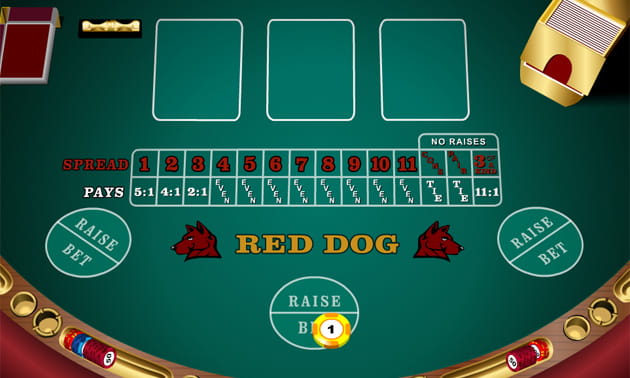
The demo below runs on play credits. It is worth a few rounds before reading on, because the spread mechanic makes more sense once you have watched it happen.
 Play
PlayHow to Play Red Dog – Beginner’s Guide
Red Dog is dealt from between one and eight standard 52-card decks. Aces are always high and deuces always low, with everything in between ranked as you would expect. Unusually for a casino game, more decks means a lower house edge here, so an eight-deck table is a slightly better bet than a single-deck one. Suits do not matter at any point.
Red Dog Rules – Learn How to Play
A round runs in three steps. You post an ante, two cards are dealt face up, and then you decide whether to raise before the third card is turned. Everything hinges on what those first two cards are:
- Consecutive cards, such as a 7 and an 8, end the hand immediately as a push. Your ante comes back and no third card is dealt.
- A pair means a third card is dealt straight away with no raise offered. If it matches, you are paid 11 to 1. If it does not, the hand is a push.
- Anything else creates a spread, and you choose whether to raise before the third card lands.
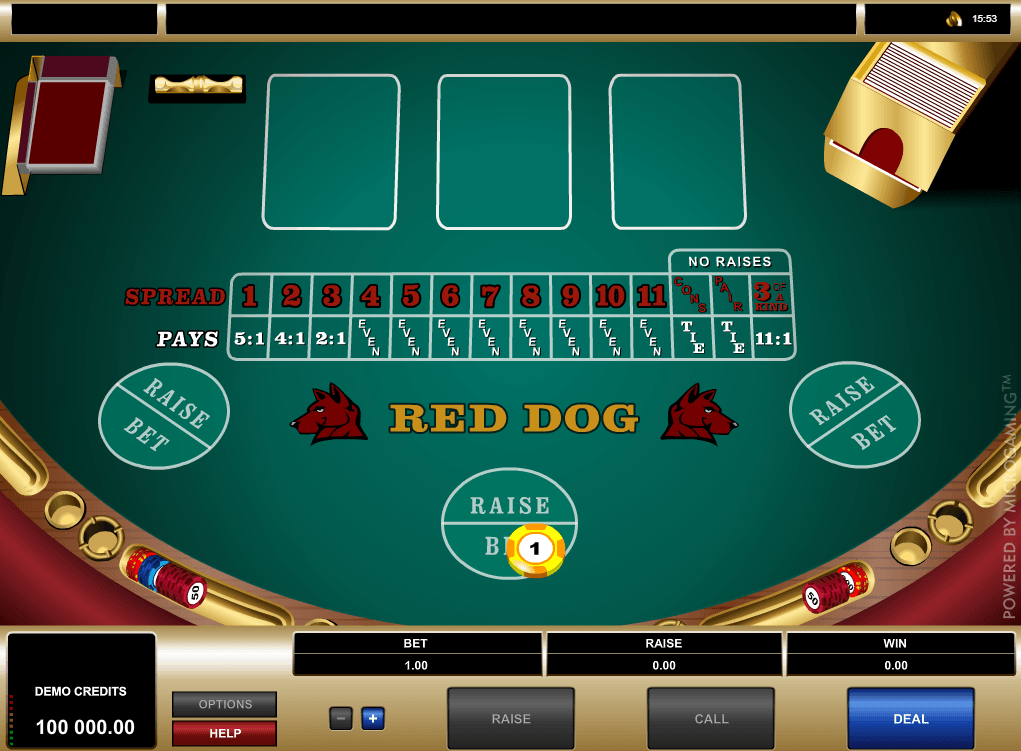
The spread is simply how many ranks sit between the two cards. A 3 and a 10 give a spread of 6, because a 4, 5, 6, 7, 8 or 9 would land between them. Win if the third card falls inside that gap, lose if it falls outside or matches either card. Your one decision is:
- Raise – also called Ride. You add a second bet equal to your ante before the third card is dealt.
- Call – also called Stand. You leave the ante as it is and take the third card without adding anything.
Note that you can never lose more than you have already staked by declining to raise. The raise is optional and always costs exactly one extra unit, so the decision is purely about whether the gap is wide enough to be worth it. The next two sections cover the card values and then exactly where that line sits.
Red Dog – The Card Values
The wider the spread, the more likely the third card lands inside it, which is why reading the gap quickly matters. The one value people get wrong is the ace, which is always high in Red Dog and never counts as 1. Here is the full ranking.
| Red Dog Card | Value |
|---|---|
| 2 – 10 | Face Value |
| Jack | 11 |
| Queen | 12 |
| King | 13 |
| Ace | 14 |
Red Dog is not a game that varies much between venues. The pay table and the rules are essentially standard everywhere, with the only real difference being the number of decks in the shoe. That makes it one of the few casino games where what you learn on one table transfers to every other.
Payouts by Spread
The payout depends entirely on the size of the gap, and it moves in the opposite direction to your chance of winning. A narrow spread pays well because it rarely hits; a wide one pays even money because it usually does. The table below gives every spread with what it pays and how often the third card actually lands inside it, counted from a single 52-card deck.
| Spread | Cards That Win | Pays | Chance of Winning |
|---|---|---|---|
| Consecutive (no gap) | – | Push | – |
| 1 | 4 | 5:1 | 8% |
| 2 | 8 | 4:1 | 16% |
| 3 | 12 | 2:1 | 24% |
| 4 | 16 | 1:1 | 32% |
| 5 | 20 | 1:1 | 40% |
| 6 | 24 | 1:1 | 48% |
| 7 | 28 | 1:1 | 56% |
| 8 | 32 | 1:1 | 64% |
| 9 | 36 | 1:1 | 72% |
| 10 | 40 | 1:1 | 80% |
| 11 (2 and ace) | 44 | 1:1 | 88% |
That table contains the whole strategy of the game. Because a raise pays even money on any spread of 4 or more, it is only worth making when your chance of winning is better than 50%. A spread of 6 wins 48% of the time, so raising loses money. A spread of 7 wins 56% of the time, so raising makes money. That is exactly why the rule is to raise at 7 and not before.
The pair is the one outcome that works differently. When the first two cards match, a third is dealt straight away and you are not offered a raise. Match all three and the payout is 11 to 1, the biggest in the game. Anything else is a push, so a pair costs you nothing either way, which makes it the one free roll on the table.
Simple rules do not make it a soft game. The high payouts sit on the narrow spreads for a reason: a spread of 1 pays 5 to 1 but lands only 8% of the time, which is a considerably worse deal than the even-money bets further down. Every row in that table except the wide spreads is priced against you.
The good news is that the one decision you get is fully solved, and our strategy section covers it in a sentence. First, though, the house edge, which in Red Dog behaves in a way that surprises most players.
House Edge and RTP
The house edge is the share of your stake the casino expects to keep over the long run, and RTP is the same number seen from your side. Every casino game has one, and the aim is simply to play the versions where it is smallest.
In Red Dog the figure depends on the number of decks, and it moves the opposite way to almost every other card game. In blackjack, more decks are worse for the player. Here, more decks are better: a single deck costs 3.155%, while an eight-deck shoe costs 2.751%. The reason is that with more cards in play, removing the two face-up cards has less effect on how many cards remain inside the spread.
| Number of Decks | House Edge |
|---|---|
| 1 Deck | 3.155% |
| 2 Decks | 3.077% |
| 4 Decks | 2.884% |
| 6 Decks | 2.798% |
| 8 Decks | 2.751% |
RTP is the same number seen from the other side: subtract the house edge from 100. An eight-deck game returns 97.25% and a single-deck game 96.85%, both of which are respectable figures, comfortably better than most slots, though a step behind blackjack and baccarat. The practical takeaway is short: if a lobby offers both, pick the table with more decks. The difference is small, around four tenths of a percent, but it costs nothing to take.
Online Red Dog Card Games – Live and RNG Variations
Red Dog comes in two forms online: an RNG version and, less commonly, a live dealer table. The game has largely disappeared from brick-and-mortar floors, where it was squeezed out by faster and more profitable table games, so online is now where you will find it at all. That has upsides.
- Free demo versions, which no land-based table offers
- No time pressure on the raise decision in RNG games
- Lower minimums than a physical table would carry
- The deck count is stated in the rules screen, so you can pick the better version
The RNG version puts you alone against the software with no clock running, which suits a game whose only decision benefits from a moment’s thought. Live tables add a dealer and a betting window, and they never come with a demo mode.
NetEnt, Playtech and Games Global, formerly Microgaming, are the studios most associated with Red Dog, though it is a niche title for all three and not every lobby stocks it.
Whether you can reach a table at all depends on where you play: our US casino guide and Philippines casino guide cover the licensed sites in each market, along with the payment methods and legal rules that apply there.
Top Red Dog Tips – Learn How to Win
Red Dog gives you one decision per hand, and the correct answer to it is already known. There is no reading, no bluffing and nothing to count, so the tips below are less about playing well than about not paying more than the game asks. Start with the spread table and everything else follows from it.
Here are our top tips:
- Raise only on a spread of 7 or more. That is the point where your chance of winning passes 50% and the extra bet starts paying for itself. The reasoning is here.
- Never raise on a spread of 1, 2 or 3. The bigger payouts look tempting but all three are priced well against you.
- Pick the table with the most decks. Unlike most card games, Red Dog gets cheaper as decks are added, from 3.16% down to 2.75%.
- Learn the card values properly. Aces are always high, which means a 2 and an ace is the widest spread on the table at 11.
- Practice on the demo until reading the gap is instant. Miscounting the spread is the only real mistake available in this game.
- Set a budget before you start. Rounds are quick and a raise doubles your exposure, so a session moves faster than it looks.
- Know when to stop. Set a time limit alongside your budget, and never chase losses.
That last point deserves its own section, because it is the only piece of strategy the game has.
Red Dog Strategy – When to Raise
Red Dog has the shortest optimal strategy of any casino card game. Raise when the spread is 7 or more. Call on everything else. That is the complete rule, and it holds whatever the deck count.
The reasoning is straightforward. The raise pays even money on any spread of 4 or more, so it is only worth adding when the third card is more likely than not to land in the gap. A spread of 6 wins 48% of the time and a spread of 7 wins 56%, which puts the break-even point neatly between them. On a spread of 1, 2 or 3 the raise pays more, but the win rate falls to between 8% and 24%, far below what those payouts are worth.
What the rule cannot do is make the game profitable. It only stops you handing back the two or three percent that separates a well-played session from a badly played one. The ante itself always carries the house edge, and no decision you make touches it.
Final Thoughts
Red Dog is about as simple as casino card games get. Two cards, one decision, and a rule that fits in six words: raise on a spread of 7. Follow it and the game costs you between 2.75% and 3.16% depending on the deck count, which is decent value and better than most slots.
What it will not give you is much to do. There is no skill to develop past the first five minutes and no variation between tables worth hunting for, which is largely why it vanished from casino floors. As a quiet, cheap game to play a few hands of, though, it holds up.
If you want a card game against the dealer with more decisions in it, our Pai Gow Poker guide covers one where how you play genuinely matters.
Popular Questions
Here are the questions players ask most often about Red Dog.
1. How to play red dog poker?
Red Dog is a super easy game to learn: you post an ante, two cards are dealt face up, and you bet on whether a third card lands between them in rank. The payout depends on how wide the gap is. Despite the name it is often given online, it is not actually a poker game.
2. What are the red dog game instructions?
A round of Red Dog has three steps, covered in full in the rules section. You post an ante, two cards are dealt face up, and you decide whether to raise before the third card is turned. Consecutive cards push, a pair deals a third card automatically, and anything else creates a spread you bet on.
3. Where can I find a free red dog card game?
In case you feel uncertain of your skills or level of comprehension of it, we always encourage our readers to test the waters and try Red Dog's demo version. It'll provide you with first-hand experience and allow you to build confidence before you jump in with your real money.
4. How can I always win at red dog poker?
No approach can guarantee a win, but the Red Dog strategy is fully solved. Play with multiple decks to reduce the house edge, and raise only when the spread is 7 or higher. Nothing you do removes the house edge on the ante itself.
5. Can I play red dog games on the go?
Yes. Red Dog is optimized to work smoothly on any recent device, running directly in your phone's browser with the same rules and payouts as on desktop. Both the RNG and live versions are available on mobile.
6. How can I improve my odds to win a red dog game?
There are always ways to improve your Red Dog odds. Raise only on a spread of 7 or more, and pick tables with more decks to lower the house edge. Luck still decides each round, but those two habits keep the game as cheap as it can be.
7. What are the red dog poker payouts?
Know your Red Dog payouts and you will be able to estimate your odds of winning, as the two are closely related. Knowing what you will be paid for a specific outcome allows you to make more informed decisions about whether to raise your bet or not. This can prove very cost-efficient.
8. What are the best red dog poker casinos?
There are a number of great casinos where you can enjoy a game of Red Dog. The best venues are licensed and regulated. You can find licensed operators in our US gambling guide or our Philippines casino guide.