Slot Machine Volatility: What It Means and How to Pick Your Level
 By John Isaac,
Chief Editor at online-gambling.com
John Isaac
Chief Editor at online-gambling.com Slot volatility (also called variance) describes how a slot spreads its payouts over time. A low volatility slot pays small amounts often. A high volatility slot machine pays rarely, but the wins that do land can be hundreds or thousands of times your stake.
Two slots can share the same RTP and still feel completely different to play. Volatility in slots is the reason. It decides how bumpy the ride is, how long a bankroll lasts and how big the top prize can be, without changing what the game returns in the long run.

What Does Volatility Mean in Slots?
Every spin on a slot is decided by a random number generator. In plain terms, the volatility meaning in slots is the shape of the wins. Picture two games that both return 96% over millions of spins.
Game A hands back that 96% as a stream of wins worth one to ten times your stake. Game B returns almost nothing for long stretches, then pays 500x or more in one bonus round. Same return, very different risk. Game A is low volatility, Game B is high.
Three numbers tell you most of what you need to know. Hit frequency is the share of spins that pay anything. Max win is the cap on a single spin, quoted as a multiple of the bet. RTP is the long-run return, explained in our slot RTP guide.
TIP: RTP and volatility are independent, so Blood Suckers can return 98% at low volatility while Dead or Alive 2 returns 96.8% with a 100,000x top prize.
Hit frequency is not the same thing as volatility either. San Quentin xWays pays something on about 34% of spins, more often than Starburst at 23%. The difference is that most of San Quentin’s hits are worth less than the stake, while the rare bonus can pay 150,000x.
Providers label volatility in their own way. Most use the words low, medium and high, sometimes with a one to five scale of stars or lightning bolts. Quickspin scores games out of five. Nolimit City rates from 1 to 10 and has stamped a few releases as 11 or 12.
There is no industry standard. One slot can carry different labels on different sites, and when they disagree the published hit frequency and max win are the firmer ground. Our online slots guide covers the other panel terms.
Our slot machine volatility list uses one scale across all three tables. Low, medium and high are our labels, and where a studio publishes a rating of its own we put that in brackets beside ours.
- Low volatility – returns most of its RTP as frequent small wins, so the balance moves in small steps and dead streaks are short.
- Medium volatility – pays often enough to keep a session moving, and the bonus round can reach a few thousand times the stake.
- High volatility – concentrates its RTP in rare events such as a bonus round or a chain of multipliers, so base game spins often return less than the stake.
Low Volatility Slots
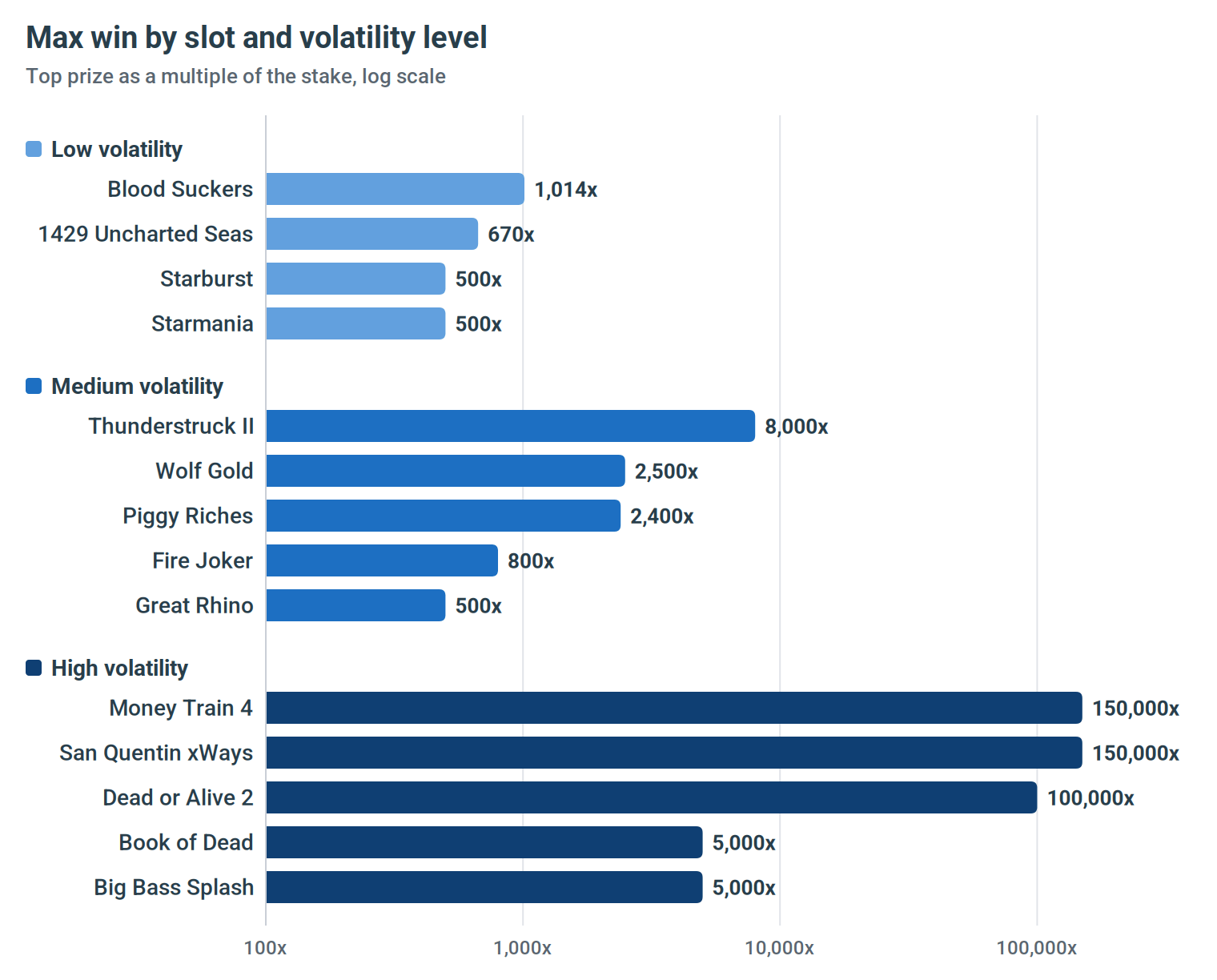
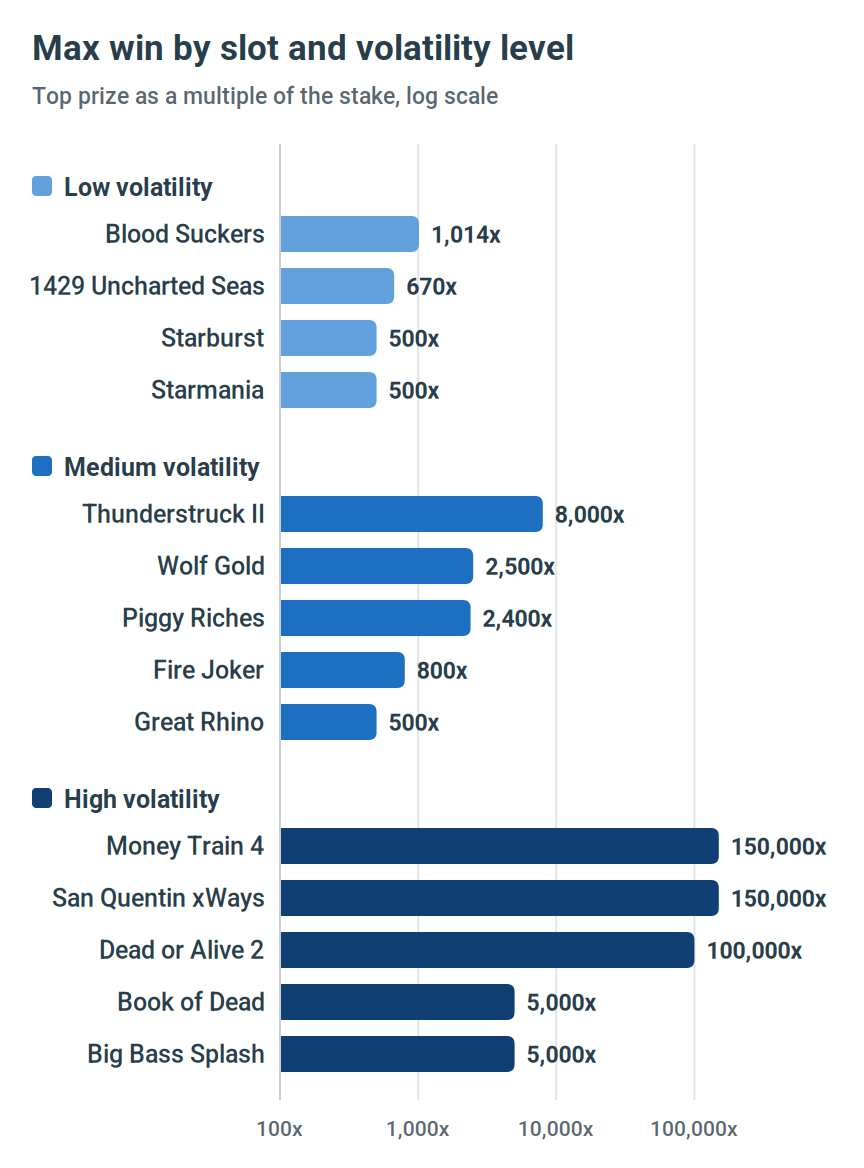
Published hit frequencies here run from 23% to 45%, which is between one spin in four and almost one in two. Max wins sit between 500x and 1,014x the stake.
These games suit players who want long sessions from a small budget, who are clearing a wagering requirement, or who dislike long dead streaks. The trade-off is a low ceiling: a 1,014x max win at a $0.20 stake is about $203, and even that is rare.
The classic fruit machine layout with 10 to 25 paylines and no big multiplier feature is typically where low volatility lives. Every max win in the table was checked against at least two independent sources, because provider spec panels are not always right.
These are four of the best low volatility slots, each with its published figures.
| Slot | Provider | Volatility label | RTP | Max win | Hit frequency |
|---|---|---|---|---|---|
| Starburst | NetEnt | Low | 96.09% | 500x | 23% |
| Blood Suckers | NetEnt | Low | 98.00% | 1,014x | 45% |
| 1429 Uncharted Seas | Thunderkick | Low | 98.60% | 670x | 41% |
| Starmania | NextGen (Light & Wonder) | Low to medium | 97.87% | 500x | Not published |
Blood Suckers is the standout: a 98% RTP makes it one of the slowest bankroll burners in any lobby, and 1429 Uncharted Seas returns more still at 98.6%. NetEnt puts the hit frequency of Blood Suckers at 45%, the highest in this group.
Labels vary by source. Starmania is widely rated low to medium, and some slot reviews file Starburst there too. Read the label as a range.
Medium Volatility Slots
Max wins here run from 500x to 8,000x, and few providers publish a hit frequency for this group.
This is the largest category and the one most casual players end up in. Most five-reel video slots with a free spins feature and moderate multipliers land here. Games with fixed jackpots, such as Wolf Gold and Great Rhino, are also usually medium because the jackpot caps the top prize.
Five of the best medium volatility slots are listed below.
| Slot | Provider | Volatility label | RTP | Max win | Hit frequency |
|---|---|---|---|---|---|
| Thunderstruck II | Games Global | Medium | 96.65% | 8,000x | Not published |
| Wolf Gold | Pragmatic Play | Medium | 96.01% | 2,500x | Not published |
| Piggy Riches | NetEnt | Medium | 96.38% | 2,400x | 34% |
| Great Rhino | Pragmatic Play | Medium | 96.53% | 500x | Not published |
| Fire Joker | Play’n GO | Medium | 96.15% (default version; lower variants exist) | 800x | Not published |
Thunderstruck II has the highest ceiling among the five above at 8,000x, and Great Rhino the lowest at 500x, held down by the Grand Jackpot that caps its top prize.
Some slot reviews file Thunderstruck II as medium, while others call it high variance on the strength of that 8,000x ceiling. It is the one row here where the label is contested.
High Volatility Slots
Max wins run from 5,000x to 150,000x, and studios such as Nolimit City and Relax Gaming now build games around six-figure multipliers.
Published hit frequencies vary widely here, from about 20% for Money Train 4 to 34% for San Quentin xWays, which is why hit frequency alone cannot tell you how volatile a game is. What matters is that a large share of those hits pay less than you bet.
The table lists five of the best high volatility slots.
| Slot | Provider | Volatility label | RTP | Max win | Hit frequency |
|---|---|---|---|---|---|
| Dead or Alive 2 | NetEnt | High | 96.80% | 100,000x | 30% |
| Book of Dead | Play’n GO | High | 96.21% | 5,000x | Not published |
| Money Train 4 | Relax Gaming | High | 96.10% | 150,000x | 20.14% |
| San Quentin xWays | Nolimit City | High (10 of 10 on the studio’s own scale) | 96.03% | 150,000x | 34.25% |
| Big Bass Splash | Pragmatic Play | High | 96.71% | 5,000x | Not published |
Dead or Alive 2 is the benchmark. NetEnt’s site publishes a 96.8% RTP and a 30% hit frequency, and Evolution’s game page puts the High Noon Saloon ceiling at 100,000x the bet. The same payout structure means a full session can pass with no bonus at all.
Book of Dead and Big Bass Splash cap at 5,000x, modest next to Money Train 4, yet both are high volatility because nearly all the value sits in the free spins. Progressive jackpot slots behave similarly: the jackpot contribution comes out of every spin, so base game returns are lower.
High volatility slots suit players with a bankroll of several hundred stakes who accept that most sessions will end in a loss. They are the wrong choice for wagering requirements with a time limit, because the bonus may never arrive before the clock runs out.
Low vs Medium vs High Volatility: Comparison
The table puts the three levels side by side. Hit frequency and max win ranges are taken from the published figures of the titles named on this page. The bankroll column is our guideline for a 200-spin session and is explained in the bankroll section below.
| Volatility | Hit frequency | Max win range | Bankroll for 200 spins | Session feel | Example titles |
|---|---|---|---|---|---|
| Low | 23% to 45% where published | 500x to 1,014x | About 100 stakes | Steady balance, small ups and downs, few dead streaks | Blood Suckers, 1429 Uncharted Seas |
| Medium | Around 34% where published | 500x to 8,000x | 150 to 200 stakes | Regular small wins, occasional bonus worth 50x to 500x | Thunderstruck II, Piggy Riches |
| High | 20% to 34% where published, most hits below stake | 5,000x to 150,000x | 300 to 500 stakes or more | Long losing runs, then one bonus decides the session | Dead or Alive 2, Money Train 4 |
Two things stand out. First, the hit frequency ranges overlap: a 30% hit rate can belong to a low or a high volatility game. Second, the max win column does not overlap at all. If you only have one number to judge a slot by, use the max win.
How to Check a Slot’s Volatility
The paytable and the studio’s own game page reveal slot machine volatility for most games. Where both stay silent, the payout spread gives the design away.
- Game info panel – open the paytable or the “i” button. Many providers list volatility, RTP, hit frequency and max win there. If the game shows a 1 to 5 or 1 to 10 rating, that is the provider’s own label.
- Provider website – the main software providers publish RTP and often hit frequency on their studio sites. Treat their max win field with care: netent.com lists Dead or Alive 2 at 1,600x, while Evolution’s game page for the same slot gives 100,000x.
- Max win – a soft signal. Caps under roughly 1,500x lean low and caps above 5,000x lean high. A fixed jackpot caps the top prize on its own: Great Rhino stops at 500x and is still a medium volatility game.
- Paytable spread – compare the payout for five of the top symbol with the payout for three. A gap of 50x or more between them points to high volatility; a gap under 10x points to low.
- Bonus frequency – some review databases publish how often the free spins trigger. One bonus per 100 to 150 spins is typical for medium volatility; one per 200 to 450 spins signals high.
- Demo play – two hundred free spins will not prove anything statistically, but long runs of zero-win spins in the base game are the fingerprint of a high volatility design.
Paylines or ways to win tell you little about volatility on their own. A 243-ways slot can be low volatility and a 10-line slot can be extreme. What matters is the payout spread.
None of these checks changes your odds. The RTP is fixed by the game’s math and no reading of the paytable moves it. Stake size, game choice and session length are the decisions that stay yours, and they are what how to win at slots comes down to in practice.
Volatility and Your Bankroll
The single practical use of slot volatility is stake sizing. The more volatile the slot, the more spins you need to give the bonus a fair chance of arriving. That means a smaller stake relative to your session budget.
In the Netherlands, every player sets a deposit limit before playing licensed slots in the Netherlands, which caps how far a volatile session can run.
British players face a stake cap as well: £5 a spin, or £2 for players aged 18 to 24, at every Gambling Commission licensee, including the best online casinos in the UK.
Our guideline for a 200-spin session: divide your budget by 100 for a low volatility slot, by 150 to 200 for medium, and by 300 to 500 for high. The result is your maximum stake per spin.
Worked example with a $50 session budget. On Blood Suckers (low), a $0.50 stake gives you 100 spins, which is enough to see the hit frequency at work but nowhere near enough for the RTP to settle.
On Piggy Riches (medium), drop to $0.25 to $0.30, giving 165 to 200 stakes. A free spins round is likely within the session.
On Dead or Alive 2 (high), split the same $50 into $0.10 to $0.15 stakes, giving 330 to 500 spins. Even then, a session without a High Noon Saloon bonus is normal.
TIP: If your session budget will not cover 300 spins at a high volatility slot’s minimum stake, pick a less volatile game.
The guideline sets session length; it does not make a session profitable. Over any number of spins a slot returns less than it takes; a longer session only pulls the result closer to the RTP. Set a loss limit before the first spin and stop when you reach it.
FAQ
Short answers to the volatility questions players ask most often.
1. What does volatility mean in slots?
Volatility, or variance, describes how a slot spreads its payouts. Low volatility slots pay small amounts often; high volatility slots pay rarely but the wins can be thousands of times the stake. It does not change the RTP, only how bumpy the path to that RTP feels. Providers show it as a word or a rating on the game info panel.
2. Is high volatility better than low volatility?
Neither is better, they suit different goals. High volatility slots offer the biggest max wins, up to 150,000x on titles such as Money Train 4, but most sessions end without a bonus. Low volatility slots such as Blood Suckers stretch a small budget with frequent small wins. Pick the level that fits your bankroll and how long you want to play.
3. Does volatility affect RTP?
No. RTP and volatility are separate properties set by the math model of the game. Blood Suckers has a 98% RTP with low volatility, while Dead or Alive 2 has a 96.8% RTP with high volatility. Volatility only decides whether that return comes as many small wins or a few large ones. Neither number changes during play.
4. How can I tell if a slot is high or low volatility?
Check the game info panel first, where most providers print a volatility label or rating. Then treat the max win as a soft signal: caps under roughly 1,500x lean low and caps above 5,000x lean high, though a fixed jackpot can hold a medium game well below that. A wide paytable gap between three and five of the top symbol points to high volatility.
5. What is a medium volatility slot?
A medium volatility slot balances win frequency and win size. Max wins run from a few hundred to a few thousand times the stake, and few providers publish a hit frequency for these games. Thunderstruck II, Piggy Riches, Wolf Gold, Great Rhino and Fire Joker are medium volatility examples. Most five-reel video slots with a free spins feature fall into this group.
6. What is hit frequency and is it the same as volatility?
Hit frequency is the share of spins that pay anything, whatever the amount. It is related to volatility but not the same. San Quentin xWays pays on about 34% of spins yet is rated 10 of 10 for volatility, because most hits return less than the stake. Starburst pays on 23% of spins and is low volatility because its wins are close to the stake in size.
Final Thoughts
Volatility in slots tells you how a game pays, not how much. Match the level to your budget: low for long sessions on small stakes, medium for a balance of action and bonus potential, high only when you can afford several hundred stakes.
Whatever the level, every slot returns less than it takes over time, and no stake pattern changes that. Set a budget you can afford to lose, treat any win as a bonus and stop when the limit is reached.
Volatility works the same way wherever you play, but the games on offer differ by market. The slots available in the US depend on the state, since online casinos are licensed state by state.
The game list is different again for online slots in the Philippines.