How Slot RTP Works and Which Games Pay Back Most
 By John Isaac,
Chief Editor at online-gambling.com
John Isaac
Chief Editor at online-gambling.com 
RTP, short for return to player, is the share of all money wagered that a slot is designed to pay back over its lifetime. A slot with a 96% RTP keeps 4 cents of every dollar staked and returns 96 cents, measured across millions of spins rather than one session.
The higher the RTP, the less the game costs you per spin in the long run. Most modern online slots sit between 94% and 96.5%. The table below lists the 20 best RTP slots, several of them paying back 98% or more in their best configuration.
Highest RTP Slots
Every RTP figure on this page was checked against the provider’s own game sheet or two independent game databases, and the version of the game that the figure applies to is stated. Slots we could not verify were left out.
The table ranks the best RTP slot machines from highest to lowest return. Eight of the twenty slots reach their headline figure only in a specific mode or at a specific bet level, and the RTP column names the condition; the other twelve pay their rate on every spin.
TIP: Operators can license lower RTP variants of many of these games, so the number in your casino’s info panel may differ from the one shown here.
| Rank | Game | Provider | RTP | Volatility | Release year |
|---|---|---|---|---|---|
| 1 | Ugga Bugga | Playtech | 99.07% | Low | 2006 |
| 2 | Book of 99 | Relax Gaming | 99.00% | High | 2021 |
| 3 | Mega Joker | NetEnt | 99.00% (Supermeter mode at max bet) | High | 2008 |
| 4 | Ooh Aah Dracula | Barcrest (Light & Wonder) | 99.00% (Hi Roller mode; 96% base game) | Medium | 2015 |
| 5 | Jackpot 6000 | NetEnt | 98.90% (10-coin bet; about 95% below) | High | 2007 |
| 6 | 1429 Uncharted Seas | Thunderkick | 98.60% | Low | 2014 |
| 7 | Marching Legions | Relax Gaming | 98.12% | High | 2020 |
| 8 | Blood Suckers | NetEnt | 98.00% | Low | 2009 |
| 9 | Rainbow Riches Pick ’n’ Mix | Barcrest (Light & Wonder) | 98.00% (Big Bet mode; 94% to 96% base game) | Medium to high | 2016 |
| 10 | Jokerizer | Yggdrasil | 98.00% (Jokerizer mode; 88.8% base game) | High | 2016 |
| 11 | Starmania | NextGen (Light & Wonder) | 97.87% | Low to medium | 2015 |
| 12 | White Rabbit Megaways | Big Time Gaming | 97.77% (with Feature Drop; 97.24% base game) | High | 2017 |
| 13 | Medusa Megaways | NextGen (Light & Wonder) | 97.63% (Buy Pass only; 96.28% base game) | High | 2018 |
| 14 | Devil’s Delight | NetEnt | 97.60% | Medium | 2013 |
| 15 | Retro Reels Extreme Heat | Games Global | 97.50% | Medium | 2011 |
| 16 | Big Bad Wolf | Quickspin | 97.34% | High | 2013 |
| 17 | Jack Hammer 2 | NetEnt | 97.07% | Low to medium | 2012 |
| 18 | Steam Tower | NetEnt | 97.04% | Medium | 2015 |
| 19 | Hotline | NetEnt | 97.04% (three Hotlines active; 96.13% base game) | Medium | 2018 |
| 20 | Wild Swarm | Push Gaming | 97.03% | Medium to high | 2018 |
Among the top 10 highest RTP slot machines in casinos, only Ugga Bugga and Book of 99 pay 99% or better on every spin.
Mega Joker reaches 99% in Supermeter mode at the maximum bet and drops to about 76.9% at the minimum by third-party estimates, while Ooh Aah Dracula hits 99% only in its paid Hi Roller rounds.
Jackpot 6000, Rainbow Riches Pick ’n’ Mix, Jokerizer and Hotline work the same way, each with a cheaper base game underneath.
The always-on figures are the useful ones for normal stakes. 1429 Uncharted Seas, Marching Legions and Blood Suckers all sit at 98% or above with no conditions attached.
Both Megaways entries need a caveat. White Rabbit Megaways only passes 97.7% when you use the Feature Drop to buy the bonus, and Medusa Megaways reaches 97.63% only through its Buy Pass. On organic spins Medusa runs at 96.28%, which would not make this table at all.
UK-licensed casinos disable bonus buys, so British players get the base-game figure on both.
Progressive jackpot slots rarely appear on lists like this one because part of every bet feeds the jackpot pool rather than the base game. If a life-changing prize matters more to you than the long-run return, progressive jackpot slots make that trade-off on purpose.
Paylines, bonus features and the other mechanics of online slots shape how a game plays, while RTP sets what it pays back over time.
What Does RTP Mean in Slot Machines?
Return to player is a theoretical figure that the provider calculates before a game is released, and how it is built sets the limits of what it can tell you.
- A math model – the provider calculates RTP from every symbol’s weighting on every reel, every payout in the paytable, and the odds of triggering each feature.
- An independent check – games built for regulated markets are submitted to an accredited test lab, which checks the math model against the certification rules of that market.
- A very large sample – the published number only becomes reliable as the spin count climbs into the millions, which is why it describes the game over its lifetime.
- Not one session – over 100 or 500 spins your realized return can land anywhere from zero to several thousand percent, because a single bonus round or a dry run dominates such a small sample.
- The house edge in reverse – house edge is 100% minus the RTP, so a 96% slot has a 4% edge and a 99% slot has a 1% edge.
RTP and House Edge Are the Same Number Seen From Two Sides
The table below shows what a few percentage points of RTP are worth on $1,000 of total bets, which for a $1 spin is 1,000 spins, or roughly one to two hours of play.
| Slot RTP | House edge | Expected loss per $1,000 wagered | Expected return |
|---|---|---|---|
| 99% | 1% | $10 | $990 |
| 98% | 2% | $20 | $980 |
| 97% | 3% | $30 | $970 |
| 96% | 4% | $40 | $960 |
| 94% | 6% | $60 | $940 |
| 92% | 8% | $80 | $920 |
| 88% | 12% | $120 | $880 |
The gap between a 96% and a 99% slot is $30 for every $1,000 wagered. That is modest for a casual player and very real for anyone who plays regularly.
It also shows why no slot can be beaten by strategy: even the best game in the table still has a positive house edge.
Theoretical Versus Realized RTP
Some regulators publish the payout achieved on real bets. Nevada’s Gaming Control Board, for example, reports monthly slot win percentages by coin denomination. Realized figures like these swing in either direction from month to month, and only converge on the published RTP over a long period.
TIP: If a casino shows you a “live RTP” badge, treat it as a short-term snapshot.
RTP Versions and Why the Same Slot Pays Differently
Many providers ship a slot with several certified RTP settings, and the casino chooses which one to run. A game advertised at 96.5% may be live at 94%, 92% or lower at a casino that picked a cheaper configuration.
The graphics, features and volatility are identical, so nothing on screen gives it away except the info panel.
Two things create these differences. The first is the configurable range described above.
The second is game modes such as Supermeter, Hi Roller or Big Bet, where the slot pays at a higher rate only while you use the mode, usually at a higher stake or for a fixed price per round.
What Regulators Require
Regulators set floors and disclosure rules, and these differ by market:
- United Kingdom – the Gambling Commission’s RTS 3C standard requires information on the chances of winning to be easily available before you bet, and accepts the RTP, the house edge or the probability of winning events. It sets no minimum RTP, and all licensed UK online casinos must follow it.
- New Jersey – the state’s casino rules (N.J.A.C. 13:69E-1.28A) require each slot game to have a theoretical RTP of at least 83%.
- Nevada – Gaming Regulation 14.040 requires every gaming device to theoretically pay out at least 75% of all amounts wagered, for each wager available on the device.
Those floors are far below what any of the RTP slots in our table pays. The minimum protects players from extreme machines, while the actual RTP a casino runs is a commercial decision.
Checking the info panel before you play is the only way to know which version you have loaded.
In the US, each state’s regulator approves the games, so check which titles and payout figures apply at the best slot sites in the US.
RTP vs Volatility vs Hit Frequency
RTP tells you how much a slot pays back in total. It says nothing about how that money arrives. Two slots with an identical 96% RTP can feel completely different, and that difference comes down to two other measures.
Volatility describes how widely results swing. A low-volatility slot pays small amounts often and rarely wipes out a balance quickly; a high-volatility slot pays rarely, then pays big. Our slot volatility guide covers the ratings and how to read them.
Hit frequency is the share of spins that produce any win at all, and NetEnt publishes it on its game sheets: 45% for Blood Suckers, 17% for Mega Joker.
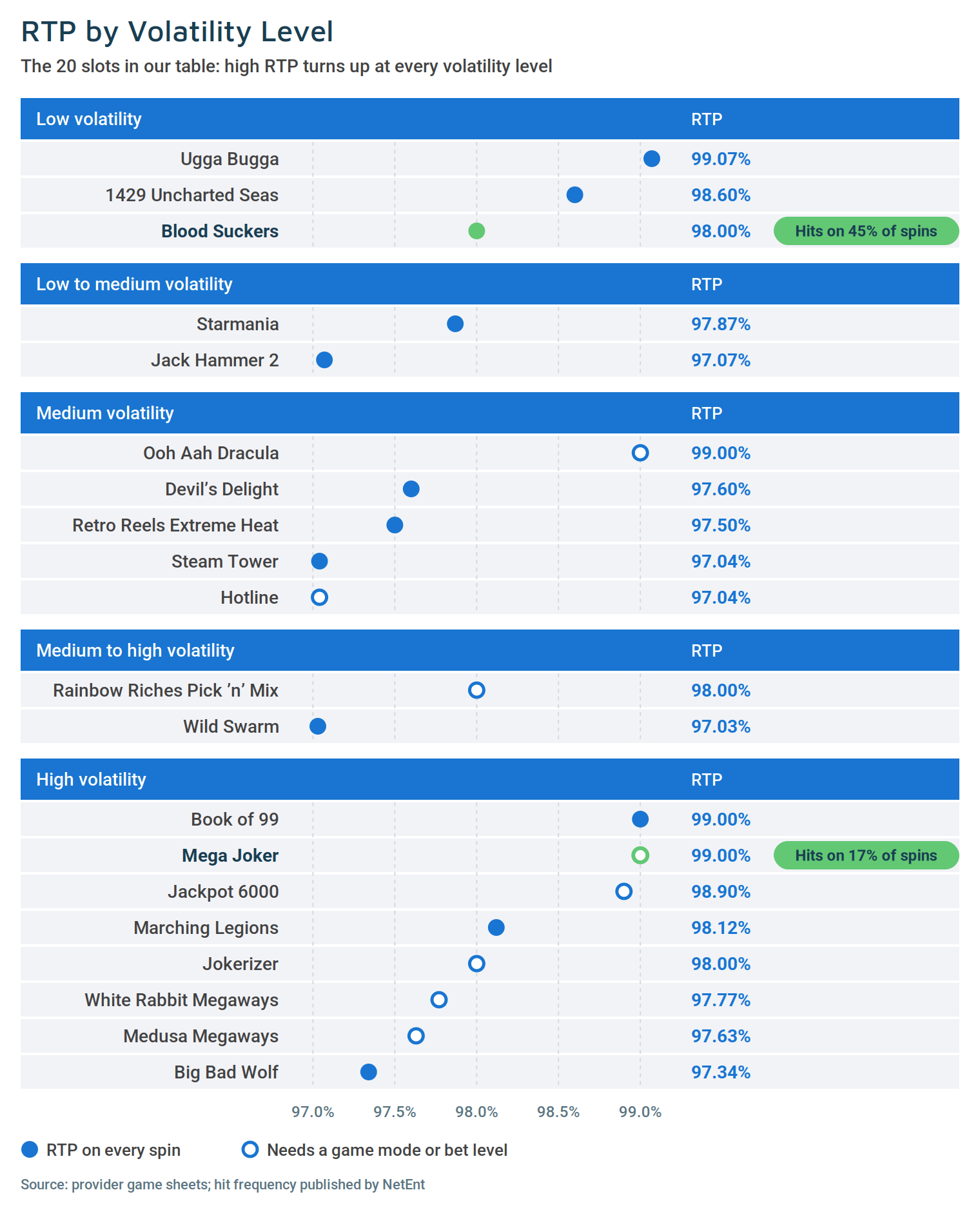
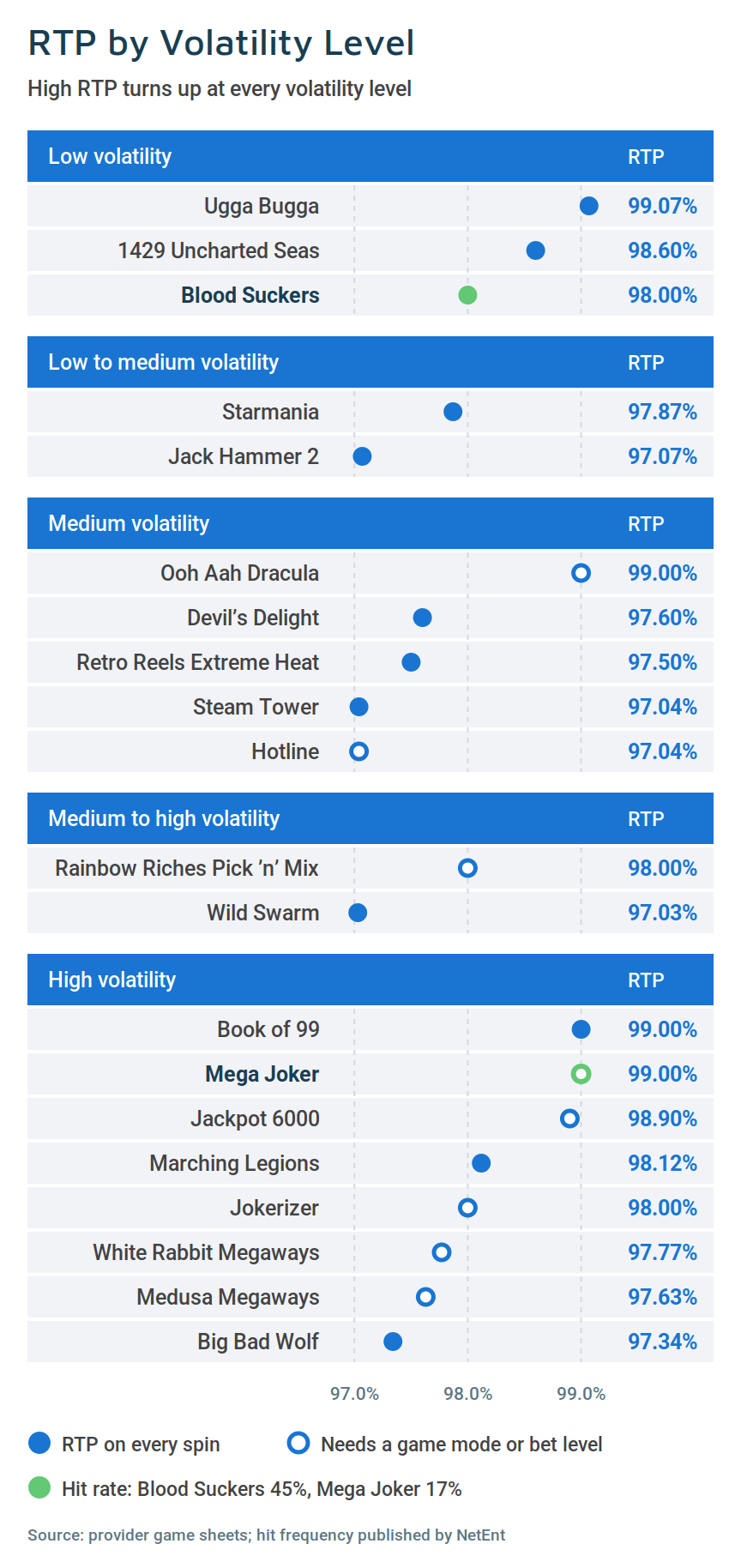
At the same 96% RTP, a high hit frequency means lots of small returns, while a low one concentrates the money in a few large hits.
None of the three numbers can be changed by how you press the button or when you play. What you can control is bankroll, session length and game choice, which is what our how to win at slots guide is about.
Picking high RTP slots is the single biggest lever a player has, and even then the edge stays with the house.
How to Check a Slot’s RTP
You should never have to guess. Three checks take under a minute:
- Open the game and tap the information or “i” button, then scroll to the rules or paytable. In the UK and most EU markets you will find it here, and this is the most reliable place to see the exact version the casino is running.
- Compare that number with the provider’s own game page. If the casino shows a lower figure than the provider’s headline RTP, it is running a reduced variant.
- Check an independent game database if the provider does not publish its RTP. If two databases agree, that is a reasonable substitute for an official sheet.
Each studio review in the slot software providers hub carries its RTP tables, which helps when you meet an unfamiliar title. Some casinos also publish a page listing the RTP of every game in their collection, which saves loading each slot in turn.
If the information panel shows no RTP at all, treat that as a warning sign about the casino. Every reputable studio publishes the figure, and regulated markets expect the chances of winning to be easy to find before you bet.
FAQ
Short answers to the questions players ask most often about slot RTP.
1. What is a good RTP for a slot?
Anything at or above 97% counts as high for an online slot, and the games in our table go up to 99% or more in their best mode. Around 96% is the industry norm and is neither good nor bad. Below 94% the house edge starts to bite, and progressive jackpots often sit lower still because part of each bet funds the prize pool.
2. Is 96% RTP good?
It is average rather than good. A 96% RTP means the slot keeps $4 of every $100 wagered over the long run, which is roughly where most modern video slots are set. Compared with a 99% game it costs you an extra $30 per $1,000 in bets, so if two slots appeal to you equally, the one nearer 97% or 98% is the cheaper choice.
3. Does a higher RTP mean more wins?
No. RTP measures how much money comes back in total, whatever the win rate. How frequently you win is set by the game’s hit frequency and volatility, which are independent of RTP. A 98% slot with high volatility can go many spins without paying, while a 94% slot with low volatility pays small amounts constantly. Higher RTP means a lower long-run cost.
4. Can casinos change the RTP of a slot?
Not while you play, and not by themselves. Providers certify several RTP versions of many slots, and the casino chooses which one to license. Once a version is live it cannot be adjusted spin by spin, and every outcome still comes from a certified random number generator. The version in use is shown in the game’s information panel, which is why checking it matters.
5. Which slot has the highest RTP?
Ugga Bugga by Playtech has the highest default RTP we could verify at 99.07%, followed by Relax Gaming’s Book of 99 at 99.00%. Mega Joker and Ooh Aah Dracula also reach 99%, but only in their Supermeter and Hi Roller modes. All four still carry a house edge of at least 0.93%, so none of them is a way to beat the casino.
6. Why is my actual return different from the RTP?
Because RTP is an average over millions of spins, and one session is a tiny sample. Over a few hundred spins a single bonus round can push your return far above 100%, and a dry run can push it well below 90%. Neither result says anything about the slot’s programming. The longer you play, the closer your realized return drifts toward the published figure.
7. Do progressive jackpot slots have a lower RTP?
Usually, yes. A share of every bet on a networked progressive is diverted into the jackpot pool, and that contribution counts toward the RTP even though almost nobody ever receives it. The base game you actually play therefore returns less than a comparable non-progressive slot, and many of the biggest progressives publish total RTPs in the high 80s or low 90s.
Final Thoughts
RTP is the one number that tells you what a slot costs to play over time, and the difference between a 94% game and a 98% game adds up fast.
Use the table to pick the best RTP slots, confirm the version in the casino’s info panel, and remember that every slot on this page still favors the house.
Set a budget you can afford to lose before you spin, and stop when it is gone.
RTP rules and the slots on offer vary by market. The game list is different again for slots in the Philippines, so check the RTP in each game’s info panel before you play.
Dutch players choose from licensed slots in the Netherlands, where a deposit limit applies to every account.